

Boston, MA and the Netherlands: two worlds apart that share one common interest…

Boston and the Netherlands joined forces during BIO 2012

…If you’re thinking winning sports teams, try again. (Hup holland, anyone?) However, if your second guess was the common interest of life sciences, then you hit the nail on the head. Remember when BIO 2012 happened back in June and more than 16,000 attendees from all around the world attended this massive biotech conference? (Need a refresher? We wrote several blog posts about TRA360’s experience here). With international pavilions galore and representatives from companies in the biotech, life science and pharmaceutical industries, collecting business cards and establishing relationships were top priorities on everyone’s mind.

Seeing as the life science industry is a major part of what we do here at TRA360, we are always looking to expand our network and meet new people in the business, both locally and internationally. While trolling the Internet recently, an article from the International Business section of Boston.com entitled, “Partnering Opportunities In The Life Sciences Between Boston and the Netherlands” caught my eye. Check out what makes both Boston and the Netherlands so compatible with their mutual interest of life science (facts taken from Boston.com):

  • Several MA life sciences companies are using the Netherlands as part of their European operations.
  • Dutch life sciences recognizes Boston as a center of innovation in the life sciences, and sees it as an important entry point for the business of the Dutch life sciences companies in the United States.
  • MA life sciences companies may want to explore setting up a presence in the Netherlands
  • Many executives in the life sciences industry in the Netherlands worked in Boston earlier in their career, and several Dutch entrepreneurs have founded biotech companies in the Boston Area

As you can see, the Netherlands and Boston’s mutual interest in the life sciences has essentially established a benchmark for understanding business practices and building relationships.

Did you attend BIO 2012? What other countries do you think has the potential to collaborate with the US in the bio/pharma/life science industries? What do you think is in store for the future between Boston and the Netherlands? Let us know your thoughts!  

More on the Technology of Harvard Apparatus

Infrared Imaging, Harvard Apparatus

Welcome back and here we are again with Harvard Apparatus. You might ask what else Harvard Apparatus has for technology, and here we are with your answer. They use electro spinning and infrared cameras to assist researchers.

Electro spinning is a relatively new technology where charged liquid goes through an electromagnetic field. Once it travels through the field the polymer within the liquid threads itself on the drum and creates a scaffold of homogeneous thickness. The voltage in the electromagnetic field causes the polymer to become strand-like and intertwine with itself on the drum. The cells adhere to the thin proliferation on the drum and create the tissue necessary. In order to produce different morphologies and orientations of tissues, the parameters of both the polymer and the process can be adjusted. However, mapping can be difficult since the polymers do not intertwine the same way every time.

Harvard Apparatus also uses infrared cameras to monitor the function of organs. In the past there was no easy way to detect how a donor organ is functioning without using dyes or stains. Dyes and stains, however effective, negatively affect the organ and may make them unusable to be transplanted. The picture from the infrared camera uses the water content and the temperature of the cells in the organ to see how they’re functioning. This technology can be used as well to identify the exact spot a heart attack is occurring so a surgeon can inject stem cells after the attack to help the body repair the damaged cardiac tissue. It can also be used to diagnose and predict the appearance of a burn over a month later after only three hours so that treatment can be administered significantly sooner.

Using these two technologies, Harvard Apparatus is enabling researchers to make large advancements in the world of medicine and specifically regenerative medicine. Stick around as next time we will investigate how researchers used these and the technologies mentioned in our last blog to regenerate full organs, like the trachea to give people a whole new life. What do you think of this new technology? Let us know @TRA360!

The Apparatus in Harvard Apparatus

InBreath Bioreactor, Harvard Apparatus

As promised we’re back with more on the apparatus of Harvard Apparatus. In our last blog we talked about the mechanical syringe pump and the Ex Vivo Profusion System, but now we’re looking into the bioreactors used by researchers to advance their abilities to create synthetic organs in the future.

Once they discovered that their technologies could be used to regenerate organs, Harvard Apparatus began research and development into the ways to improve the bioreactors for regenerative medicine. They started to develop bioreactors in all different sizes and shapes for each organ. For example, there have been all different shapes of tracheas needed for transplantation and Harvard Apparatus has been able to create bioreactors that can accommodate individual trachea.

The InBreath™ Bioreactor goes inside of an incubator to maintain a sterile field in an environment required to help to grow the organ. Also, the InBreath™ Bioreactor enables the stem cells that are growing to be stimulated in a manner similar to that in the body. Inside of the bioreactor, the cells are exposed to both a liquid environment that resembles the mucous that the trachea is exposed to and the air environment that as a windpipe the trachea would experience. This helps the stem cells to grow and differentiate into the correct type of cells by stimulating them.

But how do you know when an organ is ready? Harvard Apparatus thought about this too. There is no alternative to the experience of a world leading surgeon. They supplement this with the ability to measure certain metrics of the physiology of organs. The surgeon can manipulate the trachea and monitor the metrics and decide when the organ is ready to be transplanted.

But that’s all for now, check back next time for more about the technologies brought to us by Harvard Apparatus. Let us know what you think so far @TRA360!

Start Biotechnology, End Changing Regenerative Medicine

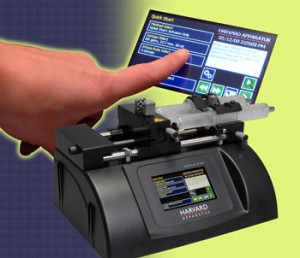
Mechanical Syringe Pump, Harvard Apparatus

Ready for more regenerative medicine? We visited with the technical staff at the Harvard Apparatus Regenerative Technology group of Harvard Bioscience. Harvard Bioscience is a Holliston, MA based company that provides technology used throughout the field of regenerative medicine. The current management took the company from a $10 M to $110 M in the last 15 years, that’s more than a tenfold increase. As important as their net worth is, that isn’t what’s most important at this company. Harvard Bioscience strives to make the best possible equipment for the scientists who use their technology and reduce their research time.

Harvard Apparatus has two major technologies that are advancing science right now. The first is a clinical infusion syringe pump targeting the safety and accuracy of delivering medicine to patients in hospitals. When liquids need to be delivered at a constant and precise volume per unit of time, especially when the volumes are low, injection by hand is ineffective. Harvard Apparatus is the world leader in high precision research syringe pumps allowing doses as low as microliters per minute over an extended period of time at a programmable rate. This is combined with technology to maintain cells allowing precise delivery in cellular therapy applications such as injecting stem cells.

They also are optimizing an ex vivo isolated organ perfusion system. This system allows organs to be maintained outside the body and the effects of new drugs and treatments tested on actual organs.  

These technologies may not suggest regenerative medicine from first glance, so how did they get started with regenerative medicine? President David Green identified regenerative medicine as a possible new field to enter based on the technologies already being pioneered by the company. The Ex Vivo Profusion System as they knew it was a Bioreactor to some of their customers. The ability to keep organs alive outside of the body enabled the decellularization of organs—taking all of the donor cells out to enable stem cells from the patient to grow within the scaffolding of the organ and become a new organ. Combining collaboration with leading scientists and additional R&D on their Bioreactors, the company identified and are implementing what scientists and researchers need to advance research.

Want to know more about the bioreactors and what else Harvard Apparatus has to offer? Come check out our next few posts on their technology and how it’s being applied today. What do you think about bioreactors and their syringe pump? Let us know @TRA360!